
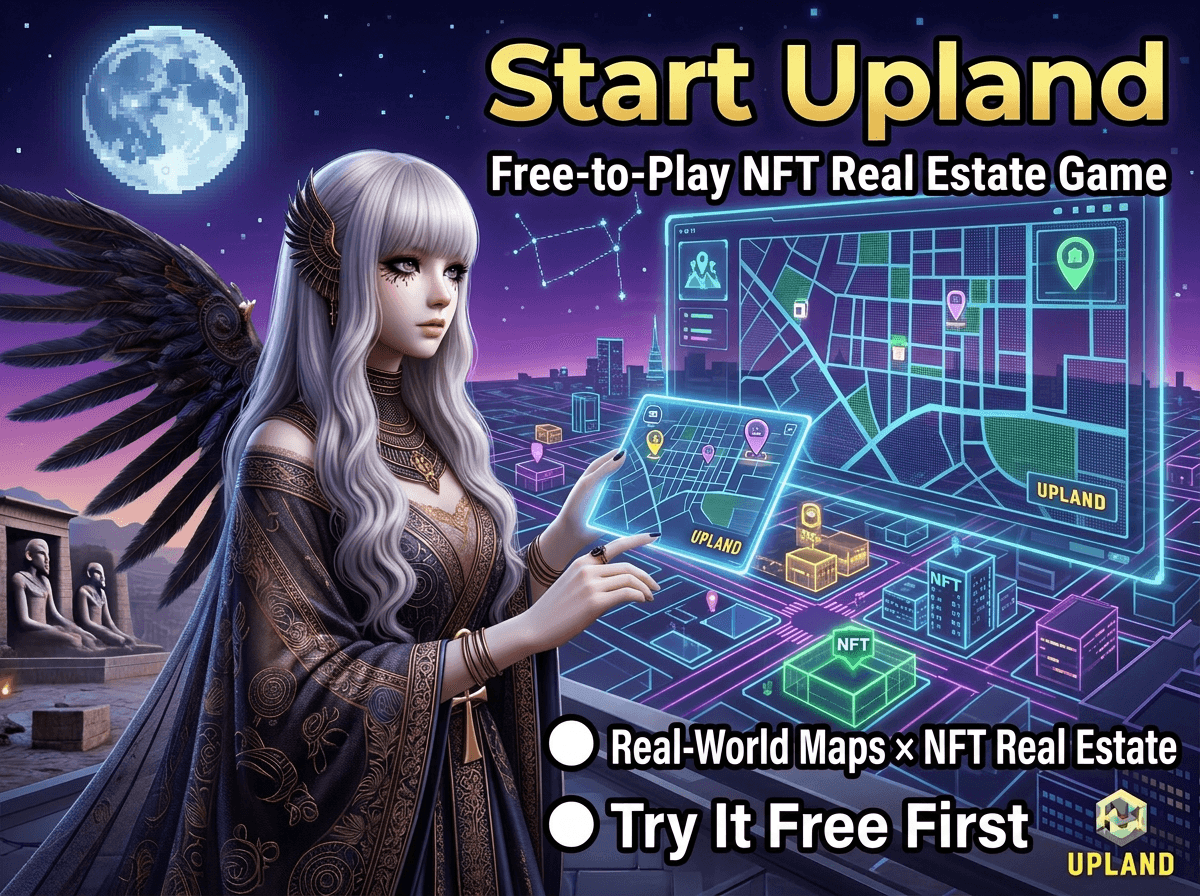
Start Upland | A Free-to-Play NFT Real Estate Game
This article contains referral links (PR). Bonuses may be offered for first-time purchases, subject to change by the operator.
Upland is an NFT real estate game where real-world addresses are turned into virtual properties.
You can buy, collect, sell, and build on properties through a browser or smartphone app, and the basic flow is relatively easy to understand.
If you are thinking:
“I’m not sure NFT games are for me”
“I don’t want to spend money right away”
Upland is one of the easier titles to try for free first and decide later.
If you want to understand the in-game currency first, read What Is UPX in Upland?.
This page is a starting point for Upland. If you want a deeper look at how the system works, check the detailed guide linked near the end of this page.
What kind of game is Upland?
In simple terms, Upland is an NFT real estate game built around real cities and real addresses.
Most of what you do falls into four categories:
- Buy properties tied to real-world addresses
- Build up a collection
- Trade properties and manage your assets
- Take part in building features and events
This is not a flashy action game.
It is better suited to people who enjoy maps, cities, property systems, and collecting.
Who is it for?
Upland may suit you if:
- You like maps and cities
- You do not mind looking at property values and market movement
- You enjoy slow, incremental progression
- You want to try something for free before committing
It is probably not a good fit if:
- You only care about making quick money
- You want a game centered on combat or action
- You hate reading through layered systems and rules
- You are not willing to keep an eye on market conditions or events
What you should know before starting
Upland can be started for free.
That said, it is easy to misread the game if you approach it as an easy way to make money.
At minimum, keep these points in mind:
- Its in-game currency is not designed to be freely sold outside the platform
- How easily you can sell assets depends on market demand
- Beginner protection comes with restrictions as well
If you want the detailed mechanics, it is faster to move on to the full guide linked later.
A safe way to get started
For most people, this is enough:
- Sign up for free
- Spend a little time clicking around
- Get as far as your first property purchase
- Decide whether the game fits you
- If it does not, stop there
You do not need to obsess over yield, resale strategies, or optimization from day one.
The more important question at the start is whether this is a game you can actually see yourself continuing to play.
Early on, it is more useful to ask whether the mix of maps, trading, and collecting feels right for you than to ask whether it can make money.
Common concerns
Do NFT games shut down quickly?
That concern is valid.
Upland is not guaranteed to last forever.
Still, it has at least been running since 2019, and its core idea—using real-world maps as the base—is easy to understand.
Can you actually make money from it?
There is room to sell assets, but this is not the kind of game where anyone can make money easily.
You need to understand supply and demand, location, timing, and the platform’s rules.
For the distinction between UPX and USD asset sales, see Can You Earn Money in Upland? UPX, USD Sales, Fees, and Limits Explained.
For readers who want the full picture
This page is only an introduction.
If you want to look into the system in more detail, including yield, FSA, USD sale requirements, SPARKLET, and the main risks, move on to the full guide.
A full guide for readers who want to understand how Upland works, including its structure, restrictions, yield model, USD sale requirements, beginner protections, and supply controls.
Try it for free first, then decide
What makes Upland approachable is that it lets you test whether a real-world map-based NFT real estate game is actually for you without a large upfront commitment.
On the other hand, if you go in expecting easy profits, you will probably misjudge it.
If you are curious, trying it for free first is enough.
If you start through this link and complete your first property purchase, you may receive a bonus. The offer details and conditions can change at any time on the operator’s side.